📞 +91 74289 00759 | ✉ info@prolightworks.com | 📍 Delivering Pan India


How to Choose the Right Commercial Lighting Supplier for Your Next Project
Choosing the right commercial lighting supplier is one of the most important decisions in any commercial lighting project. While product quality certainly matters, the success of a project often depends on the supplier’s ability to understand your requirements, recommend suitable lighting solutions, and support the project from planning through procurement.
Commercial lighting decisions influence much more than illumination. They affect functionality, user experience, aesthetics, energy efficiency, maintenance requirements, project timelines, and long-term operating costs. Whether you’re planning an auditorium, television studio, hotel, educational institution, architectural façade, or public infrastructure project, selecting the right lighting partner can significantly improve project outcomes.
Many buyers compare suppliers primarily on price or product availability. However, commercial lighting projects require a broader evaluation. Technical expertise, application knowledge, multi-brand options, BOQ support, procurement capability, and project guidance all play an equally important role.
This guide explains what a commercial lighting supplier does, the key factors you should evaluate before selecting one, and practical questions that can help you make a more informed decision for your next project.
What is a Commercial Lighting Supplier?
A commercial lighting supplier helps businesses evaluate, source, and procure lighting solutions for commercial and professional projects. Beyond supplying products, experienced suppliers assist customers with application guidance, product selection, technical recommendations, BOQ support, and procurement planning to help ensure the chosen lighting solutions align with project requirements.
Quick Summary
Before selecting a commercial lighting supplier, evaluate more than product pricing. A reliable supplier should be able to:
✔ Understand your project requirements
✔ Recommend suitable lighting solutions for the application
✔ Offer technically appropriate product options
✔ Support BOQ evaluation and procurement
✔ Provide multi-brand choices where appropriate
✔ Ensure dependable project support before and after supply
The right supplier becomes a project partner—not simply a product vendor.
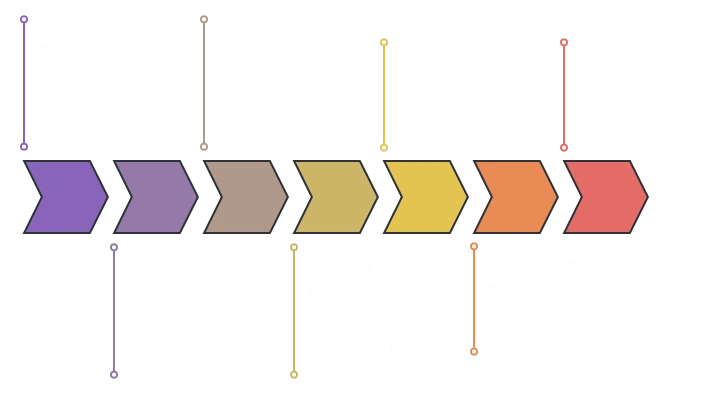
Lighting Solutions Buyer Journey
Why Choosing the Right Commercial Lighting Supplier Matters
Every commercial project is unique. A hotel lobby requires a completely different lighting approach than a television studio. An auditorium demands different performance characteristics than a temple or heritage monument. Even two projects within the same industry may require different lighting strategies depending on architecture, user experience, operational requirements, and budget.
This is why selecting an industry-specific lighting solutions supplier should never be based solely on who offers the lowest price.
An experienced supplier looks beyond the product catalogue. They seek to understand how the space will be used, what the lighting is expected to achieve, and which products are best suited for that specific application.
Choosing the right supplier can help you:
- Identify lighting solutions that match your project objectives.
- Reduce the risk of selecting unsuitable products.
- Improve procurement efficiency.
- Compare multiple lighting options objectively.
- Receive guidance before finalising specifications.
- Balance performance, budget, and long-term value.
- Simplify coordination across different project stakeholders.
In contrast, selecting a supplier based only on product availability or pricing can lead to unsuitable product choices, compatibility issues, delays, higher maintenance costs, and expensive changes during project execution.
Commercial lighting is not simply about buying fixtures—it is about making informed decisions that support the overall success of the project.
What Does a Commercial Lighting Supplier Do?
Many people assume that a lighting supplier simply sells lighting products. In reality, experienced commercial lighting suppliers contribute much earlier in the project lifecycle.
Their role often begins when project requirements are still being discussed and continues until the products are successfully delivered.
Depending on the project, a commercial lighting supplier may help with:
- Understanding project requirements
- Evaluating the intended application
- Identifying suitable lighting categories
- Comparing multiple product options
- Reviewing technical specifications
- Assisting with BOQ interpretation
- Suggesting practical alternatives where appropriate
- Supporting procurement planning
- Coordinating product availability
- Assisting throughout the supply process
Rather than recommending products in isolation, experienced suppliers evaluate how each recommendation contributes to the project’s functional, operational, and commercial objectives.
Supplier vs Project Lighting Partner: What Should You Expect?
Not every lighting supplier provides the same level of project support. A product-focused supplier may primarily fulfil product requirements, while a project lighting partner takes a broader approach to understanding the application, evaluating options, and supporting procurement.
| Evaluation Area | Products Supplier | Project Lighting Partner |
|---|---|---|
| Primary focus | Supplying requested products | Understanding the project and recommending suitable solutions |
| Approach | Product-first | Multi-brand |
| Requirement understanding | Works mainly from product specifications or buyer requirements | Understands the project’s application, objectives and requirements |
| Product recommendation | Offers products from the available range | Evaluates suitable options based on application and technical requirements |
| Brand approach | May be limited to a specific brand or product portfolio | Can compare suitable options across multiple brands where appropriate |
| Technical guidance | Provides basic product information | Helps evaluate specifications, compatibility and application suitability |
| BOQ support | Primarily quotes against the BOQ | Can review requirements and support BOQ-based product recommendations |
| Procurement support | Focuses mainly on order fulfilment | Supports product selection, availability, timelines and procurement coordination |
| Project involvement | Usually ends or reduces after quotation/order | Remains involved through relevant stages of the procurement process |
| Problem solving | Suggests available products or alternatives | Helps identify practical alternatives based on project requirements |
| Communication | Transaction-focused | Project-focused and collaborative |
| Long-term value | Primarily measured by product price and supply | Measured by suitability, procurement reliability, support and overall project outcome |
For complex commercial lighting projects, the difference can be significant: the right partner helps you make better lighting decisions, not simply complete a purchase order.
10 Factors to Consider Before Choosing a Commercial Lighting Supplier
Every supplier may claim to offer quality products and competitive pricing. However, these factors alone rarely determine project success.
Which Supplier Should I Choose?

Before making a decision, evaluate the following areas-
1. Industry Experience
Commercial lighting requirements vary significantly across industries. A supplier who understands stage lighting may not necessarily understand architectural façade lighting. Likewise, the requirements of television studios differ greatly from educational institutions or hospitality projects.
Look for suppliers who demonstrate an understanding of your project’s application rather than simply promoting products.
Questions to consider:
2. Product Range
Commercial projects rarely rely on a single product category. A typical project may require architectural lighting, control systems, studio lighting, stage lighting, outdoor lighting, or façade lighting depending on the application.
A supplier offering a wider range of lighting categories can often simplify procurement while ensuring better compatibility across the project.
3. Technical Understanding
Lighting decisions should be supported by technical knowledge rather than product brochures.
An experienced supplier should be comfortable discussing:
- Beam angles
- Colour temperature
- CRI
- IP ratings
- Power consumption
- Control protocols
- Mounting requirements
- Application suitability
Technical discussions help ensure products perform as expected after installation—not just on paper.
4. BOQ Support
Many commercial projects begin with a Bill of Quantities (BOQ). An experienced supplier should be able to review the BOQ, identify product requirements, highlight missing information where necessary, and recommend suitable product categories without unnecessarily complicating the procurement process.
Even when specifications are still evolving, early BOQ discussions can reduce procurement risks and improve quotation accuracy.
- Beam angles
- Colour temperature
- CRI
- IP ratings
- Power consumption
- Control protocols
- Mounting requirements
- Application suitability
Technical discussions help ensure products perform as expected after installation—not just on paper.
5. Multi-brand Options
Every lighting manufacturer has strengths in different product categories. Limiting a project to one brand may sometimes restrict available options.
Suppliers who work with multiple brands can often recommend products based on project suitability rather than manufacturer limitations. This provides greater flexibility when balancing technical performance, availability, and budget.
6. Product Availability
The most suitable product still needs to be available when the project requires it.
Before finalising a supplier, understand:
- Product lead times
- Import timelines (if applicable)
- Inventory availability
- Alternate product options
- Delivery planning
Reliable procurement depends on realistic availability rather than optimistic commitments.
7. Project Support
Commercial lighting projects often involve architects, consultants, contractors, system integrators, procurement teams, and end users.
Good suppliers remain engaged throughout the project rather than ending their involvement after issuing a quotation. Project support may include:
- Technical discussions
- Product clarification
- Procurement coordination
- Quotation revisions
- Alternative recommendations
- Coordination with manufacturers where required
Strong project support often becomes invaluable when project requirements evolve.
8. Warranty and After-sales Support
Warranty should be viewed as one part of a broader support system. Before selecting a supplier, understand:
- Manufacturer warranty terms
- Service procedures
- Replacement timelines
- Technical assistance
- Support responsibilities
Clear communication regarding after-sales processes reduces uncertainty later in the project lifecycle.
9. Delivery Capability
Commercial projects frequently involve phased deliveries, multiple locations, and strict timelines.
Evaluate whether the supplier can support:
- Project-based delivery schedules
- Multiple delivery locations
- Coordination with contractors
- Packaging suitable for commercial projects
- Delivery tracking and communication
Reliable logistics are just as important as product quality.
10. Communication & Responsiveness
Commercial projects frequently involve phased deliveries, multiple Perhaps the most underestimated factor is communication.
Responsive suppliers help keep projects moving. Look for suppliers who:
- Respond promptly to enquiries.
- Ask relevant project questions.
- Explain technical concepts clearly.
- Provide transparent timelines.
- Communicate proactively throughout procurement.
Effective communication builds confidence and helps avoid misunderstandings during execution.
Expert Tip:
Rather than asking, “Which supplier offers the lowest price?”, ask:
“Which supplier demonstrates the best understanding of my project?”
Commercial lighting is a long-term investment. The supplier who understands your application, evaluates your requirements carefully, and recommends appropriate solutions often delivers greater long-term value than one competing only on price.
Common Mistakes Buyers Make
Selecting a commercial lighting supplier is often influenced by price, product availability, or brand familiarity. While these factors are important, relying on them alone can lead to avoidable challenges during project execution.
Here are some of the most common mistakes buyers make—and how to avoid them –
1. Choosing Based Only on Price
A lower quotation may appear attractive initially, but it doesn’t always represent the best long-term value. Factors such as product suitability, technical support, warranty, energy efficiency, maintenance requirements, and procurement reliability should also be considered before making a decision.
The objective should be to achieve the best overall project outcome—not simply the lowest purchase price.
2. Comparing Products Instead of Solutions
Commercial lighting is about solving project requirements, not comparing individual products. Two different products may appear similar on paper but perform differently depending on the application.
Instead of asking, “Which product is cheaper?”, ask: Which solution is more suitable for my project?”
3. Ignoring Technical Support
Many buyers assume their work ends once the purchase order is issued. In reality, commercial projects often require technical clarifications, specification discussions, coordination with manufacturers, and procurement support throughout execution.
Selecting a supplier who remains engaged after the quotation stage can significantly reduce project risks.
4. Finalising Specifications Too Early
Project requirements often evolve. Locking specifications too early without understanding all available options may limit flexibility later.
Discussing the project with an experienced supplier before finalising specifications can help identify better alternatives where appropriate.
5. Overlooking Future Maintenance
Lighting is a long-term investment. Availability of spare parts, product compatibility, warranty support, and future replacement options should all be considered during supplier evaluation—not only after installation.
6. Assuming One Solution Fits Every Project
No single lighting solution is suitable for every application. The lighting requirements of a television studio differ significantly from those of a hotel ballroom, auditorium, educational institution, or architectural façade.
Choosing solutions based on the application rather than familiarity often delivers better long-term results.
Planning a Commercial Lighting Project?
Choosing the right supplier starts with understanding your project’s requirements.
Explore our Commercial Lighting Solutions to understand how different lighting categories support commercial projects across industries.
Your Project. Our Commitment.
Questions You Should Ask Before Finalizing a Supplier
The quality of your questions often determines the quality of the supplier you choose. Before making a decision, consider asking the following:
Q1. Have you supplied lighting for projects similar to mine? – Relevant project experience often reflects a better understanding of application-specific requirements.
Q2. Can you recommend lighting solutions based on my project’s objectives rather than only the products listed? – This helps determine whether the supplier takes a consultative approach.
Q3. Can you help review my BOQ or project specifications? – Early discussions often identify missing information, alternative options, or opportunities for optimisation.
Q4. Do you offer products from multiple brands? – Multiple options allow buyers to compare solutions based on technical suitability, availability, and budget rather than being restricted to a single manufacturer’s portfolio.
Q5. How do you handle product availability and delivery timelines? – Understanding lead times early helps improve procurement planning and reduce project delays.
Q6. What kind of support do you provide after the quotation is shared? – A good supplier should remain available for technical discussions, specification clarifications, and procurement coordination throughout the project.
Q7. Who will be my point of contact during the project? – Consistent communication improves coordination between project teams, contractors, consultants, and procurement departments.
Q8. How do you support warranty and after-sales requirements? – Understanding the process before purchasing helps set realistic expectations if support is needed later.
Why Multi-brand Lighting Solutions Often Deliver Better Project Outcomes
Every lighting manufacturer has areas where they excel. Some are recognised for architectural lighting, while others specialise in stage lighting, studio lighting, lighting controls, or outdoor applications.
For this reason, many commercial projects benefit from evaluating products across multiple brands rather than limiting the entire project to a single manufacturer.
A multi-brand approach allows project teams to select products based on application suitability, technical performance, availability, budget, and project objectives, instead of adapting project requirements to fit a limited product portfolio. For example, a single commercial project may require:
- High-performance moving head lights for a performance stage
- Professional LED panel lights for a recording studio
- Architectural wall washers for the building façade
- DMX control systems for central lighting management
Each category may have different manufacturers recognised for their expertise.
Working with a commercial lighting supplier who understands multiple product portfolios provides greater flexibility during product evaluation and procurement. More importantly, it encourages discussions around the application first and the products second.
This approach aligns with the philosophy that successful commercial lighting projects begin by understanding project requirements before recommending suitable lighting solutions.
Ultimately, the objective isn’t to promote one brand over another—it’s to identify solutions that best support the project’s functional, technical, operational, and commercial goals.
Final Checklist Before You Decide
Before selecting your commercial lighting supplier, take a few minutes to review this practical checklist.
| Evaluation Area | Yes / No |
|---|
| Does the supplier understand my industry and application? | ☐ |
| Have they recommended solutions rather than simply products? | ☐ |
| Can they explain the technical reasons behind their recommendations? | ☐ |
| Are they able to assist with BOQ review or project discussions? | ☐ |
| Do they offer suitable options across multiple brands? | ☐ |
| Have product availability and delivery timelines been discussed? | ☐ |
| Is warranty and after-sales support clearly explained? | ☐ |
| Will they remain involved during the procurement process? | ☐ |
| Is communication responsive and transparent? | ☐ |
| Do I feel confident they understand my project requirements? | ☐ |
If most of your answers are Yes, you are likely working with a supplier who takes a project-focused approach rather than simply fulfilling product orders.
Final Thoughts
Choosing a commercial lighting supplier is not just about finding someone who can deliver products. It is about partnering with someone who understands your project’s objectives, evaluates your requirements carefully, and helps identify lighting solutions that are practical, technically appropriate, and commercially viable.
The right supplier contributes more than quotations—they contribute knowledge, guidance, and confidence throughout the project journey.
Whether you’re planning a new installation, upgrading an existing facility, or evaluating options for an upcoming commercial project, taking a structured approach to supplier selection can help you make informed decisions that support long-term project success.
By focusing on expertise, application understanding, technical support, procurement capability, and collaborative problem-solving, you’ll be better positioned to choose a commercial lighting supplier who adds value well beyond the products they supply.
Frequently Asked Questions
Here are answers to some of the most common questions we receive from project buyers across industries.
Can one lighting supplier handle different types of commercial projects?
Yes, provided the supplier has experience across multiple industries and product categories. Commercial lighting requirements vary significantly between auditoriums, studios, hotels, educational institutions, architectural projects, and government facilities. An experienced commercial lighting supplier understands these differences and recommends solutions based on the specific application rather than using the same approach for every project. The key is to evaluate the supplier’s project understanding, technical expertise, and product range rather than assuming every supplier has the same capabilities.
Should I choose a manufacturer or a multi-brand supplier?
There is no single answer—it depends on your project’s requirements. If your project is standardised around a specific manufacturer’s ecosystem, working directly with that manufacturer may be appropriate. However, many commercial projects benefit from a multi-brand lighting supplier who can compare products across different manufacturers and recommend solutions based on technical suitability, availability, budget, and project objectives. The goal should always be to identify the most suitable lighting solution for the application rather than limiting the project to one brand.
What information should I share before requesting a quotation?
The more information you provide, the more accurate and relevant the quotation is likely to be. Helpful information includes:
1. Project type and application
2. Location of the project
3. Drawings or layouts (if available)
4. BOQ or specifications
5. Required lighting categories
6. Quantity requirements
7. Project timelines
8. Budget expectations (optional)
9. Any preferred brands or technical requirements
Even if every detail is not available, sharing the project’s basic objectives helps the supplier recommend suitable commercial lighting solutions.
Can a supplier help before my BOQ is finalized?
Absolutely. Many commercial lighting projects begin before the BOQ is fully developed. Discussing your project with an experienced supplier during the planning stage can help identify suitable lighting categories, clarify technical requirements, suggest practical alternatives where appropriate, and support more accurate procurement planning. Early discussions often save time later by reducing revisions and helping project teams make informed decisions before final specifications are prepared.
How do I compare quotations from different suppliers?
Price should be only one part of the comparison. When evaluating quotations, consider:
1. Technical suitability of the proposed products
2. Product quality and specifications
3. Brand options offered
4. Scope of supply
5. Warranty and after-sales support
6. Product availability and delivery timelines
7. BOQ compliance
8. Project support and responsiveness
9. Overall value rather than only the lowest cost
A detailed comparison helps ensure the selected quotation supports both your project’s immediate requirements and its long-term performance.
Need Guidance for Your Commercial Lighting Project?
Every commercial project has unique lighting requirements. If you’re looking for practical guidance, BOQ support, or help evaluating suitable lighting solutions, we’d be happy to discuss your project requirements.
Our focus is to help you make informed lighting decisions—not simply recommend products.
Your Project. Our Commitment.