📞 +91 74289 00759 | ✉ info@prolightworks.com | 📍 Delivering Pan India

Understanding a Lighting BOQ: A Beginner’s Guide for Project Buyers
A lighting BOQ can look like a straightforward list of products, specifications and quantities. But for a project buyer, it is much more than a purchasing list.
A well-prepared Lighting BOQ connects the project’s lighting requirements with the products that need to be procured. Understanding what each line item means—and what information may still need clarification—can make it easier to request relevant quotations, compare options and avoid procurement issues later.
Whether you are buying lighting for an auditorium, hotel, studio, educational institution, commercial building or other professional project, knowing how to read the BOQ is an important part of making informed procurement decisions.
This guide explains the key elements of a Lighting BOQ, how to review one step by step, and what project buyers should check before sending it to a supplier for quotation.
What Is a Lighting BOQ?
Lighting BOQ stands for Lighting Bill of Quantities. It is a project document that lists the lighting products, specifications, quantities and other relevant requirements needed for a lighting installation.
A Lighting BOQ provides a structured basis for project teams, consultants, contractors and buyers to understand what needs to be supplied and to request quotations from suppliers.
Depending on the project, a BOQ may include information such as:
- Lighting product categories
- Product descriptions
- Technical specifications
- Required quantities
- Mounting or installation requirements
- Accessories
- Lighting controls
- Brand or equivalent requirements
- Special project requirements or remarks
The level of detail can vary significantly from one project to another. Some BOQs may provide detailed technical specifications, while others may contain only basic product descriptions and quantities.
This is why a buyer should not assume that every item in a BOQ is automatically ready for procurement. Understanding the application and checking the completeness of the information is an important step before finalising a purchase.
Why Is a Lighting BOQ Important?
A Lighting BOQ helps create a common reference point between the project team and the supply side.
For buyers, it can help with:
Procurement clarity:
It provides a structured list of the products and quantities required.
Quotation preparation:
Suppliers can use the BOQ to understand the requirement and prepare a more relevant quotation.
Quotation comparison:
A consistent BOQ makes it easier to compare whether different quotations are actually offering comparable products and specifications.
Quantity planning:
It provides a reference for checking whether the required quantities have been considered.
Specification control:
Technical specifications can be reviewed before products are selected and supplied.
Project coordination:
A clear BOQ can reduce ambiguity between consultants, contractors, buyers and suppliers during procurement.
A BOQ therefore acts as an important link between project requirements and lighting procurement.
What Information Does a Lighting BOQ Usually Contain?
There is no single format that every project uses. However, a Lighting BOQ will typically contain several pieces of information that help identify and procure the required lighting products.
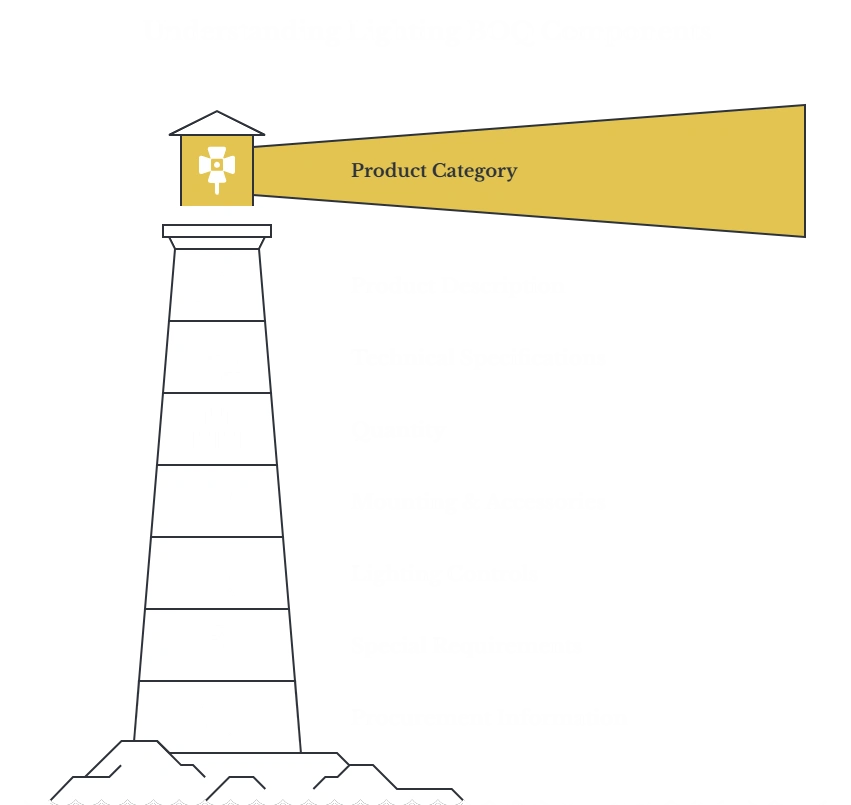
Product Category
This identifies the broad type of lighting required—for example, a downlight, panel light, spotlight, floodlight, stage fixture or architectural lighting product.
The category is important because the same project may require several different types of lighting for different applications.
Product Description
The description provides more detail about the required product.
For example, a BOQ might specify a recessed LED downlight, an adjustable spotlight or a particular type of professional project lighting fixture.
A short description alone, however, may not provide enough information to identify a suitable product.
Technical Specifications
Specifications help define what the product needs to deliver.
Depending on the application, these may include:
- Wattage
- Lumen output
- Colour temperature (CCT)
- Colour rendering index (CRI)
- Beam angle
- Dimensions
- IP rating
- Dimming requirements
- Control compatibility
- Optics
- Mounting requirements
Not every specification will be relevant to every lighting product. The requirements should be considered in the context of the intended application.
Quantity
The BOQ should indicate how many units or quantities are required.
Common units may include:
- Nos.
- Sets
- Meters
- Running metres
- Lot
Buyers should check both the quantity and the unit because an incorrect interpretation can affect the quotation and final procurement.
Mounting and Accessories
Some lighting products require specific mounting arrangements or accessories.
These may need to be identified separately in the BOQ or included within the product requirement.
For example, a project may require specific mounting hardware, drivers, suspension arrangements, trims or other accessories.
Lighting Controls
Certain commercial and professional lighting projects may include control requirements such as dimming or specific control systems.
Where controls are relevant, buyers should check whether the BOQ clearly identifies the required components and compatibility requirements.
Brand or Equivalent Requirements
Some BOQs specify a particular brand, model or approved equivalent.
This distinction matters when comparing quotations. A lower-priced quotation may not necessarily be comparable if the proposed product has materially different specifications or performance characteristics.
Remarks and Special Requirements
Remarks can contain important project information that does not fit neatly into the standard product description.
These may relate to application, installation, delivery, site conditions, control requirements or other project-specific considerations.
Buyers should review the remarks column carefully rather than treating it as secondary information.
Example of a Lighting BOQ
The following is a simplified illustration of how a Lighting BOQ might be structured:
| Item | Description | Key Specification | Qty | Unit |
|---|---|---|---|---|
| 01 | LED Panel Light | 40W, 4000K | 12 | Nos. |
| 02 | LED Downlight | 15W, 3000K | 18 | Nos. |
| 03 | Track Light | Adjustable, 3000K | 12 | Nos. |
Illustrative example only. Actual BOQ formats and specifications vary by project.
The important point is that a BOQ is not simply a list of product names. The combination of description, specification, quantity, application and project requirements determines what should actually be considered for procurement.
How to Read a Lighting BOQ: A Step-by-Step Approach
A Lighting BOQ becomes much easier to evaluate when you read it from the application and requirement first, rather than immediately looking for a product to match each line item.
1. Start With the Application
First understand where and how the lighting will be used.
A lighting requirement for an auditorium can be very different from one for a hotel, studio, educational facility or architectural installation.
The application provides context for interpreting the specifications that follow.
Ask:
- What type of space is this?
- What is the lighting intended to achieve?
- Is the requirement primarily functional, architectural, decorative or performance-related?
- Are there specific visual or operational requirements?
Understanding the application helps prevent a product-first approach to procurement.
2. Check the Product Category
Once the application is clear, identify the lighting category required for each BOQ item.
For example:
- Downlights
- Panel lights
- Spotlights
- Track lights
- Floodlights
- Stage lighting
- Studio lighting
- Architectural lighting
- Lighting controls
This gives you a clearer starting point for evaluating suitable products.
3. Review the Technical Specifications
Next, look beyond the product name and review the specifications.
Wattage alone, for example, does not tell you everything about a lighting product. Depending on the application, factors such as lumen output, CCT, CRI, beam angle, optics, IP rating, dimming and controls may be important.
The objective is not simply to find a product with a similar name. It is to determine whether the proposed product meets the relevant project requirements.
4. Check Quantities and Units
Verify the quantity specified for each item and make sure the unit is clear.
A quotation can appear cheaper or more expensive simply because quantities or units have been interpreted differently.
Check:
- Quantity
- Unit
- Sets versus individual units
- Running metres versus individual fixtures
- Whether accessories are separately quantified
5. Check Remarks and Special Requirements
Finally, review all remarks, notes and project-specific requirements.
These details may affect:
- Product selection
- Accessories
- Controls
- Mounting
- Delivery
- Availability
- Site requirements
A BOQ should therefore be read as a complete project document rather than simply as a product list.
10 Things Buyers Should Check Before Sending a Lighting BOQ for Quotation
Before sharing a Lighting BOQ with a supplier, a quick review can help identify missing information and reduce unnecessary clarification later.

1. Application
Make sure the intended application or project context is clear.
A supplier may be able to recommend more relevant options when they understand where the lighting will be used and what the project is trying to achieve.
2. Product Category
Check that each requirement is assigned to a clear lighting category.
If the description is too generic, clarification may be needed before a suitable product can be recommended.
3. Technical Specifications
Review the specifications that matter for the application.
Depending on the product, these may include CCT, CRI, lumen output, beam angle, IP rating, dimming, optics, dimensions or control compatibility.
Do not assume that a product name or wattage alone is sufficient.
4. Quantity
Verify the quantity of every item before requesting a quotation.
Even a small quantity error can affect the total project value and subsequent procurement planning.
5. Mounting Requirements
Check whether the required mounting method is specified.
For example, a fixture may need to be recessed, surface-mounted, suspended, track-mounted or installed using a particular accessory.
6. Lighting Controls
Identify whether the project requires dimming or other lighting control systems.
Where controls are required, the relevant components and compatibility requirements should be clear enough for the supplier to evaluate.
7. Accessories
Check whether drivers, mounting accessories, trims, suspension components or other required items are included or need to be quoted separately.
An apparently complete lighting quotation can become incomplete if essential accessories were not considered.
8. Brand or Equivalent Requirements
If a specific brand or product is mentioned, check whether the requirement is for that exact product or whether equivalent alternatives are acceptable.
This can significantly affect the options available for procurement and quotation comparison.
9. Project Timeline
Share the expected procurement or project timeline wherever possible.
Product availability and lead times can vary, so knowing when the material is required helps suppliers assess realistic supply options.
10. Special Requirements
Finally, check all project-specific remarks and requirements.
These could relate to:
- Site conditions
- Installation
- Controls
- Certifications
- Finishes
- Delivery location
- Phased supply
- Other project-specific requirements
The more clearly these requirements are communicated, the easier it is for a supplier to understand the project and provide a relevant quotation.
A clear BOQ does not just help a supplier quote faster. It helps everyone involved in the project work from the same understanding of what is actually required.
Have a Lighting BOQ You Need Help Understanding?
If you’re evaluating specifications, comparing product options or preparing a lighting procurement requirement, understanding the BOQ is the first step toward making an informed decision.
Common Lighting BOQ Mistakes Buyers Should Avoid
A Lighting BOQ provides a useful structure for procurement, but it does not automatically mean that every requirement is complete or ready for quotation. A quick review can help identify gaps before the BOQ is shared with suppliers.
Treating the Product Description as the Complete Specification
A product description such as “LED downlight” or “spotlight” may not provide enough information to identify a suitable product.
Depending on the application, additional specifications such as wattage, lumen output, CCT, CRI, beam angle, mounting type, IP rating or dimming requirements may be important.
Focusing Only on Wattage
Wattage is only one part of a lighting specification.
Two products with similar wattage may differ significantly in light output, beam characteristics, colour quality, optics or application suitability.
Ignoring the Application
The same lighting category can be used across very different environments.
A fixture suitable for a general commercial space may not necessarily be appropriate for a studio, auditorium, hospitality environment or architectural application.
Understanding the intended application helps put the BOQ specifications into context.
Comparing Quotations With Different Specifications
A lower quotation is not necessarily a better quotation if the proposed products do not provide comparable specifications.
Before comparing prices, buyers should first check whether the products, quantities, technical parameters and included accessories are genuinely comparable.
Missing Accessories or Control Components
Drivers, mounting accessories, trims, suspension components and control equipment may sometimes be overlooked when preparing or reviewing a BOQ.
This can result in additional costs or procurement delays later.
Not Checking Quantities and Units
Errors in quantities or units can affect both the quotation and the final project requirement.
A simple check of quantities, units and item descriptions before sending the BOQ can prevent unnecessary corrections later.
Assuming “Equivalent” Means Identical
When a BOQ permits an equivalent product, the alternative should still be evaluated against the relevant technical and application requirements.
“Equivalent” should not simply mean a product with a similar appearance or product name.
Providing Too Little Project Information
A supplier may be able to quote more accurately when the buyer provides relevant information such as the project type, location, expected timeline and specific requirements.
A BOQ without sufficient context may lead to unnecessary questions or assumptions during quotation.
Can a Lighting Supplier Help Review a BOQ?
Yes. A lighting supplier can provide BOQ lighting support by helping identify product categories, clarify specifications, evaluate suitable product options and highlight potential procurement considerations.
This can be particularly useful when:
- A product specification is incomplete
- A specified product is unavailable
- An equivalent product needs to be evaluated
- Multiple brands need to be considered
- Product availability or lead times need to be checked
- Accessories or related components may have been missed
- The buyer needs help interpreting a product requirement
For example, if a BOQ specifies a lighting category and technical requirements but the specified product is unavailable, a supplier may be able to suggest alternatives that meet the relevant requirements.
However, supplier support should not be confused with project design responsibility. The project consultant, designer or other designated technical authority remains responsible for the applicable design and specification decisions.
A supplier’s role is to provide practical product and procurement input based on the information available.
For project buyers, this distinction is useful: you can seek BOQ Lighting Support without expecting the supplier to replace the role of the project’s lighting designer or consultant.
How to Compare Lighting Quotations Against a BOQ
Comparing quotations should go beyond looking at the final price.
The first question should be:
Are the quotations actually offering comparable products and specifications?
A simple comparison can be made across the following areas:
| Check | BOQ Requirement | Quotation to Verify |
|---|---|---|
| Product | Required product/category | Proposed product |
| Specification | Required technical parameters | Quoted quantity |
| Quantity | BOQ quantity | Included or excluded |
| Accessories | Required accessories | Included or excluded |
| Controls | Required control components | Included or excluded |
| Brand | Specified brand/equivalent | Proposed brand |
| Availability | Required project timeline | Expected lead time |
| Warranty | Project requirement | Offered warranty |
| Delivery | Required location/timeline | Delivery terms |
| Price | Comparable basis | Like-for-like commercial comparison |
Start With Technical Comparability
Before comparing prices, check whether the proposed products meet the relevant BOQ requirements.
For example, if two quotations propose different CCT, CRI, beam angles or lumen outputs, their prices should not automatically be compared as though they are identical products.
Check What Is Included
Look at whether accessories, drivers, controls, mounting components and other required items are included in the quoted price.
A lower product price may not represent a lower overall procurement cost if important components are excluded.
Check Availability and Lead Time
A quotation is useful only if the proposed products can be supplied within the project’s requirements.
Check expected lead times, availability and whether the quoted timeline applies to the complete requirement or only selected products.
Then Compare the Commercials
Once the technical and supply aspects are reasonably comparable, compare:
- Unit prices
- Quantities
- Taxes
- Delivery costs or terms
- Warranty
- Payment terms
- Other applicable commercial conditions
The objective is to compare quotations on a like-for-like basis, rather than simply choosing the lowest number.
Lighting BOQ vs Lighting Product List: What’s the Difference?
A Lighting Product List primarily tells you what products are being considered or required.
A Lighting BOQ provides a more structured project procurement reference by connecting products with quantities, specifications and other relevant requirements.
| Lighting Product List | Lighting BOQ |
|---|---|
| Primarily identifies products | Connects products with project requirements |
| May contain basic product descriptions | Usually includes specifications and quantities |
| May not provide complete procurement information | Provides a structured basis for quotation and procurement |
| Useful for understanding product categories | Useful for planning, quoting and comparing project requirements |
| Can be relatively simple | Usually contains more project-specific information |
For example, a product list might simply say:
LED Downlight
LED Panel Light
Track Light
A BOQ could provide:
LED Downlight — 15W, 3000K, recessed — 18 Nos.
The second format gives the supplier and buyer considerably more information to work with.
However, the exact format and level of detail can vary between projects. A detailed product list may sometimes contain many of the same elements as a BOQ.
The key difference is how the information is structured and used for project planning and procurement.
Final Checklist Before You Send Your Lighting BOQ
Before sending a Lighting BOQ to a supplier for quotation, take a few minutes to check the following:
☐ Application is clear — The supplier has enough context to understand where the lighting will be used.
☐ Product categories are clear — Each requirement can be understood without relying on assumptions.
☐ Technical specifications are complete — Relevant parameters have been included for the intended application.
☐ Quantities have been checked — Quantities and units are accurate.
☐ Mounting requirements are identified — The required installation or mounting arrangement is clear where relevant.
☐ Lighting controls are identified — Dimming or other control requirements are included where applicable.
☐ Accessories have been considered — Required drivers, mounting components and other accessories are accounted for.
☐ Brand/equivalent requirements are clear — It is clear whether a specific brand is mandatory or suitable alternatives can be considered.
☐ Project timeline is available — The supplier knows when the material is expected to be required.
☐ Special requirements are included — Important project remarks, site requirements or other conditions have not been left out.
A clear Lighting BOQ makes it easier for suppliers to understand your requirement, recommend relevant options and provide a quotation that can be evaluated on a like-for-like basis.
Final Thoughts
A Lighting BOQ is one of the most useful documents in a commercial lighting procurement process because it creates a common reference for the project requirement. But a BOQ is only as useful as the clarity and completeness of the information it contains.
Before requesting quotations, buyers should review the application, specifications, quantities, accessories, controls, project timeline and any special requirements. When something is unclear or a specified product is unavailable, seeking appropriate BOQ Lighting Support can help identify suitable options and avoid assumptions.
Most importantly, quotations should be evaluated on a like-for-like basis. Product price is only one part of the decision; technical suitability, availability, warranty, delivery and what is included in the quotation also matter.
For complex Project Lighting requirements, taking the time to understand the BOQ before procurement can make the overall process clearer, more efficient and easier to manage.
FAQs
What information should I provide when sharing a Lighting BOQ with a supplier?
Along with the Lighting BOQ, provide as much relevant project context as possible, including the project type, location, intended application, expected procurement timeline and any specific technical or commercial requirements. If there are drawings, specifications, schedules or other documents that help explain the requirement, sharing them can also help the supplier understand the project more accurately.
Can a supplier suggest alternatives if a BOQ specification is unavailable?
Yes. If a specified product is unavailable, a supplier can suggest an alternative based on the relevant technical specifications, application and project requirements. The proposed alternative should be evaluated for suitability rather than treated as equivalent simply because it belongs to the same product category. Where design or specification approval is required, the alternative should be reviewed by the appropriate project consultant or technical authority.
Can a Lighting BOQ be prepared before the final lighting design is complete?
A preliminary BOQ or procurement list can be prepared before every aspect of the final design is complete, depending on the project’s stage and requirements. However, the level of detail and accuracy may be limited if specifications, quantities or applications are still being finalised. Buyers should clearly identify provisional requirements and confirm the final BOQ before placing the order.
How should I compare two quotations based on the same Lighting BOQ?
Start by checking whether both suppliers have quoted products that meet the same relevant specifications and quantities. Then compare accessories, controls, brand or equivalent options, availability, lead time, warranty, delivery terms and commercial conditions. Only after establishing reasonable technical comparability should you use the final price to make the comparison.
Who should verify the technical specifications in a Lighting BOQ?
The appropriate project consultant, lighting designer, architect, engineer or other designated technical authority should verify specifications that form part of the project’s design requirements. A lighting supplier can provide product information, technical clarification and procurement support, but supplier input should not replace the responsibility of the project’s designated design or technical authority.
Need Help With Your Lighting Procurement?
Share your project requirements with ProLightWorks for practical guidance on suitable commercial lighting solutions and procurement options.
Your Project. Our Commitment.